All posts
How a Playful “Grin” Conquered the Globe: The POP MART Phenomenon Explained

Imagine a creature with pointed ears, a mischievous grin, and serrated teeth leaping from a sketchbook to become a multi-billion dollar global icon. This is the story of LABUBU and POP MART, the Chinese company that has rewritten the rules of the trendy toy industry. With a market capitalization exceeding 400 billion, POP MART is pivoting the global market, captivating millions from Seoul to San Francisco. For those unfamiliar, POP MART isn’t just a toy company; it’s a cultural and commercial juggernaut that blends art, storytelling, and a dash of gambling-like thrill into collectible “blind boxes.” Its explosive growth from a single Beijing store to a global powerhouse offers a masterclass in modern consumer engagement.
At the performance briefing on August 20, 2025, founder Wang Ning conveyed astonishing growth expectations to the market in an affirmative and relaxed tone: “This year, we hoped to achieve 20 billion yuan, but it feels like reaching 30 billion should also be very easy.” Not long ago, POP MART delivered its best-ever half-year report: revenue for the first half reached 13.88 billion yuan, a year-on-year increase of 204.4%; net profit was 4.574 billion yuan, a year-on-year increase of 396.5%, with the half-year net profit exceeding that of the entire year of 2024. The revenue from the THE MONSTERS series, which includes the LABUBU product line, amounted to 4.81 billion yuan, accounting for 34.7%.
The story begins not in a designer’s studio, but in the pragmatic world of campus retail. In 2008, a 21-year-old entrepreneur named Wang Ning started a “grid store” business with friends near Sias International College in Zhengzhou. He and his team rented a shop, renovated it with multiple “grid shelves,” and sublet each grid to vendors, earning management fees and sales commissions. While successful, this model was easily copied, teaching Wang Ning a brutal lesson: entrepreneurship should venture into industries with higher business model barriers, or one must strive to quickly establish core competitiveness.
This hard-earned wisdom became the foundation for POP MART. In 2010, Wang Ning opened the first POP MART store in the Europlaza Shopping Center at Zhongguancun, Beijing. At that time, it was more like a trendy variety store, selling various novel and interesting cultural and creative products and fashionable fast-moving consumer goods. The development went through several stages. Initially, it emulated the Hong Kong trendy toy supermarket LOG-ON, acting as a distributor for global novelty toys. The turning point came when POP MART secured the exclusive licensing rights for the Molly character created by Hong Kong designer Kenny and launched its first “Molly Zodiac” blind box series on Tmall, which sold out within 4 seconds. Subsequently, POP MART eliminated all non-trendy toy categories and fully transformed into a trendy toy company centered on IP operation, a pivotal moment that set the stage for global domination.
POP MART’s astronomical rise is powered by a deceptively simple, yet psychologically potent, two-part engine.
First, the blind box model. Each box contains a random figurine from a series. The thrill of not knowing which one you’ll get—coupled with the extreme rarity of coveted “hidden” versions—taps directly into the human brain’s reward pathways. According to data analysis, the probability of drawing a hidden blind box is only 1/144. This mechanism fuels relentless repeat buying, fosters online communities for trading and collecting, and turns toys into social currency.
Second, the IP Matrix Strategy. POP MART doesn’t just sell toys; it builds worlds and characters. Its matrix-style IP development is its ultimate weapon. Taking LABUBU as an example, this IP, created by Hong Kong artist Kasing Lung, was initially a supporting character in THE MONSTERS series launched in 2017. The turning point came in 2023 when POP MART initiated its “IP Universe” strategy, constructing a complete virtual worldview and personality setting for LABUBU.
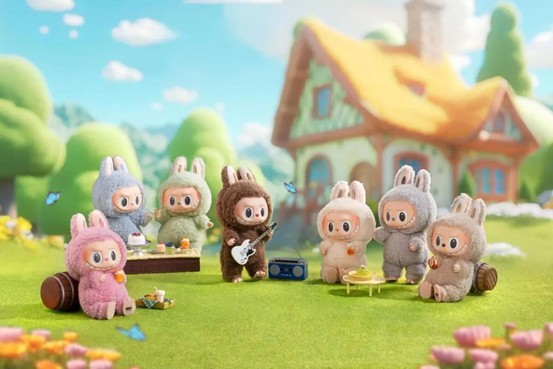
Cross-media storytelling was key to its breakthrough. In 2024, the animated short film “LABUBU’s Fantasy Diary” accumulated 230 million views on Bilibili, with related topic reads exceeding 1.5 billion. Celebrity endorsements from stars like Thai singer LISA and footballer David Beckham further propelled its global popularity. The multi-tiered IP matrix has consistently driven explosive revenue growth: in the first half of 2025, 13 IP product lines, including LABUBU, MOLLY, and SKULLPANDA, each achieved revenues exceeding 100 million yuan.

POP MART’s global ambition was not an afterthought but a core strategy, and the results are staggering. In the first half of 2025, POP MART’s overseas sales increased by 440% year-on-year, accounting for approximately 50% of total revenue, with single-store efficiency reaching four times that of domestic stores.
Their secret? Hyper-localized cultural adaptation. For different markets, POP MART adopted differentiated operational strategies. At its flagship store in Paris, POP MART associated LABUBU with elf images from French mythology in its marketing, boosting local sales by 220%. In the Middle East region, it emphasized gold color schemes and luxurious materials; the limited edition diamond-encrusted LABUBU sparked queuing and rush-buying in Dubai. In parts of Southeast Asia, LABUBU has even become a popular gift for festivals or weddings.

This cultural sensitivity is backed by a nimble, globalized supply chain. Digitalized production enables precise responsiveness—through the MES system, the production plan for the LABUBU series can be adjusted weekly. Distributed manufacturing enhances global delivery efficiency. For example, POP MART established a production base in Vietnam dedicated to the Southeast Asian market, shortening the delivery cycle to places like Singapore from 15 days to 3 days, while the factory in Mexico serves the American market, effectively avoiding 25% tariff expenses.
The Big Question: Can the Bubble Last? What POP MART Reveals About Our Future
The trendy toy industry is notoriously fickle, haunted by the “three-year curse” where most IPs fade quickly. LABUBU, now in operation for over 8 years, seems to defy this. POP MART plans to update a season of the animated storyline for LABUBU annually and develop character growth arcs, betting on “serialized” storytelling to break the cyclical curse.
This leads to the billion-dollar question: Is POP MART a sustainable business model or the ultimate collectible bubble? Data shows a shifting market. According to the “2025 China Trendy Toy Industry Development and User Behavior Survey Data” by iiMedia Research, the scale of pan-entertainment users reached 503 million in 2024. However, the market size of the “merchandise economy” surged to 168.9 billion yuan, a year-on-year increase of 40.63%. A significant 40.83% of consumers consider “having appreciation potential and being able to resell for profit on secondary markets” as their primary reason for purchase. Among purchasing factors, “style and design” rank first at 38.60%, followed by quality (36.07%) and cultural value (35.32%).
POP MART’s stock price rose from 38.6 Hong Kong dollars per share to 316 Hong Kong dollars in just one year, reflecting wild optimism. The company’s success story is a compelling case study in leveraging scarcity, community, and cross-media storytelling in the digital age. Whether its universe of playful characters can continue to grow or will eventually pop remains to be seen.
For the Business-Minded: POP MART is a blueprint for building a modern, experience-driven brand that transcends borders. It shows the power of community over traditional advertising and the critical importance of building operational barriers and a deep IP matrix.
For the Culture Watcher: It’s a lens into globalized fandom and how digital platforms can turn niche art into mainstream phenomena through cross-media narratives and celebrity amplification.
For the Consumer: Understanding the psychological mechanics behind blind boxes and the investment attributes driving the market makes you a more conscious participant in today’s attention and collectibles economy.
What do you think? Is the emotional connection to these characters a lasting cultural shift, or are we all just playing a beautifully designed game of chance? Share your perspective.