All posts
CHINASHOP and the Evolution of China’s Retail Formats: A 25-Year In-Depth Report (Part II)
CHINASHOP and the Evolution of China’s Retail Formats: A 25-Year In-Depth Report (Part I)
China’s retail evolution is not merely a local story—itrepresents one of the most complex, large-scale, and technology-intensiveretail transformations ever undertaken. From learning global standards toredefining them, China’s retailers and solution providers have moved fromfollowers to system builders and, increasingly, global reference points.
CHINASHOP’s 25-year journey mirrors this transformation.What began as a platform to address basic infrastructure gaps has become agateway to understanding how retail technology, supply chains, and AI-driven decision systems aredeveloped, tested, and scaled in real-world conditions.
As global retailers face rising costs, fragmented channels,and increasing operational complexity, China’s experience offers not a templateto copy—but a set of ideas, tools, and lessons worth studying. In this sense,CHINASHOP is no longer just a trade exhibition—it is a living archive of retailevolution, and a bridge connecting China’s retail innovations with the globalindustry.
Around 2011, China’s retail market entereda subtle but critical turning point. On the one hand, the number ofsupermarkets and hypermarket outlets reached a historical peak; on the otherhand, e-commerce platforms represented by Alibaba and JD.com began to erodeoffline market share at scale. In 2013, China surpassed the United States tobecome the world’s largest online retail market, bringing enormous survivalanxiety to traditional supermarkets. Simple merchandise displays and low priceswere no longer sufficient to retain consumers; retailers gradually realizedthat they had to seek new breakthroughs by improving operational efficiency andoptimizing customer experience.
During this period, CHINASHOP witnessed afundamental change in exhibition structure. Although shelves and checkoutcounters were still rigid necessities, their prominence was gradually overtakenby ERP (Enterprise Resource Planning) systems, WMS (Warehouse ManagementSystems), network-connected electronic scales, and early CRM (CustomerRelationship Management) systems. The core keywords of the exhibition shiftedfrom “aesthetics and sturdiness” to “data flow” and “efficiency management.”
Retailers began to pay attention to how toreduce inventory backlog through software systems, and how to conduct precisionpromotions based on membership data analysis. CHINASHOP started to attract alarge number of non-traditional suppliers, including fresh-produce packagingtechnology providers, third-party cold-chain logistics service providers, ande-commerce operation systems. This trend of integrating software and hardwaremarked that China’s retail industry shifted from a focus on “heavy-asset storedecoration” to a focus on “light-asset digitalization.”
In order to prevail in fresh-foodcompetition against e-commerce, traditional supermarkets began to deepen theirinvolvement in the supply chain. The government-promoted “company + farmer”model took effect during this period, with commercial farms gradually replacingscattered smallholder farming. This upstream transformation was reflected atCHINASHOP by the appearance of large numbers of high-tech packaging equipmentand cold-chain monitoring terminals.
Retailers no longer merely conducted spotprocurement at docks or wholesale markets, but began to establish exclusivedistribution centers (DCs) and use proprietary standards to manage suppliers.This vertical integration of the supply chain was a key indicator that theretail industry had shifted from “scale expansion” to “efficiency-driven”development.
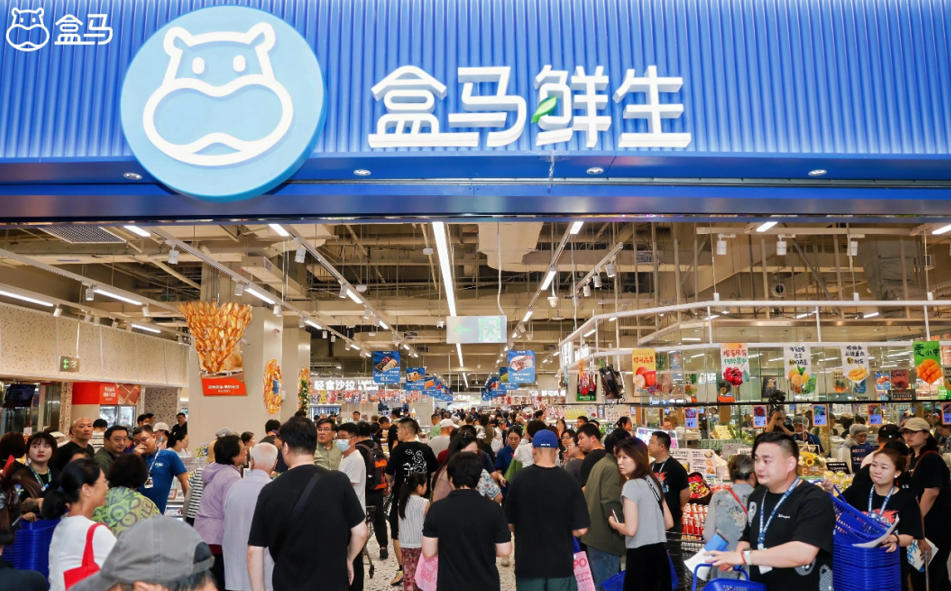
In 2016, the concept of “New Retail” wasproposed, and subsequently, new retail formats such as Hema Fresh emerged,pushing China’s retail industry into deep waters of omni-channel integration.From 2017 to 2022, digitalization was no longer an add-on module fortraditional supermarkets, but became the core engine for survival.
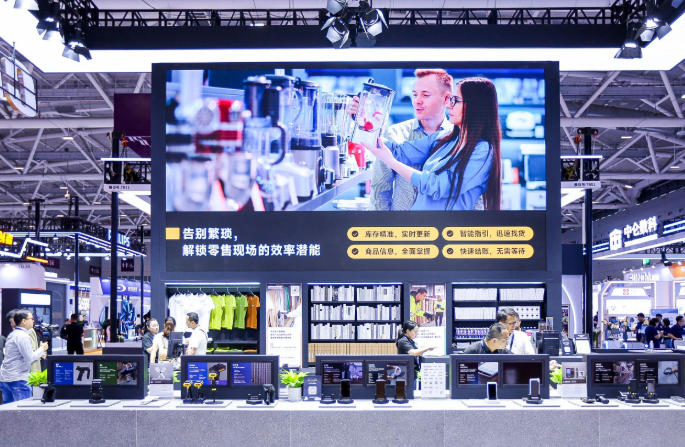
In the exhibition halls of CHINASHOP, thistransformation was presented in an extremely tangible manner: electronic shelflabels (ESL) gradually replaced traditional paper price tags, enablingsecond-level synchronization of online and offline prices; self-checkout andunmanned settlement terminals were deployed at scale, aimed at addressing thelong-standing pain point of queueing in supermarkets. At this stage, CHINASHOPincreasingly resembled a frontier technology expo, with big-data site selectionsystems, instant delivery algorithms, and computer-vision-based loss-preventionsystems becoming focal points.
With the comprehensive popularization ofmobile payments, China’s retail industry was the first globally to realizeinstant retail at scale. Supermarkets were no longer merely places for sellinggoods, but gradually assumed the function of front warehouses. At theexhibition, logistics picking systems for store–warehouse integration,automated sorting conveyor belts, and innovative solutions for takeawaypackaging emerged one after another.
By establishing the “Hi-shop Future RetailStore,” CHINASHOP demonstrated to the industry how to seamlessly connect onlinetraffic with offline space, bringing retail competition into the dimension of a“30-minute delivery radius.”
In the fourth stage, retailers began tomanage offline stores in a manner similar to internet companies. Through AIvision technologies, retailers could clearly identify the full-chain conversionrates of ‘pass-by,’ ‘store entry,’ ‘in-store browsing,’ ‘purchase,’ and ‘storeexit.’ In CHINASHOP reports from 2021 to 2022, technology enterprisesdemonstrated how ReID identification and cloud-based large models could helpoperators analyze customer behavior, such as identifying which productscustomers lingered on the longest, thereby optimizing merchandising strategies.
Entering 2023, the core theme of China’sretail industry shifted from simple data collection (digitization) tointelligent decision-making based on artificial intelligence (intelligence).Against the background of slowing industry growth and the pursuit of extremeprofitability, AI large models and reinforcement learning were no longerlaboratory concepts, but became new protagonists at CHINASHOP.
The current transformation lies in ‘AItaking over decision-making.’ In the past, supermarket ordering relied on storemanagers’ experience-based judgment; now, reinforcement-learning-basedautomatic replenishment systems can integrate multidimensional variables suchas weather, traffic, holidays, and inventory turnover rates to generate optimalordering solutions, significantly reducing waste.
At the All-Retail AI Spark Conference ofCHINASHOP 2024, discussions focused on how AI large models could assist storemanagement, automatically generate marketing content, and optimize workforcescheduling.

At the latest exhibition site, visitorscould observe multiple practical implementations of AI large models in retail scenarios.First is intelligent customer service and interaction: AI is no longer limitedto answering simple FAQs, but can understand complex shopping guidance needs.Second is AI-driven automatic inspection of SOPs (Standard OperatingProcedures).
Technology enterprises demonstrated how AIcould identify whether kitchen staff were wearing chef hats, whether fresh-foodareas were replenished in a timely manner, and whether hygiene conditions metstandards, reducing the originally expensive cost of manual store inspectionsto extremely low levels.
In addition, the application ofreinforcement learning on the supply chain side is reshaping profit structures.Green cold-chain technologies showcased by leading enterprises not only focuson refrigeration efficiency, but also link energy consumption to AI-predicteddemand, helping supermarkets and convenience stores improve net profits whileadvancing green transformation.
As a platform that has operated fortwenty-five years, CHINASHOP is no longer merely a window for introducingforeign standards. With the advancement of China’s retail technologies, anincreasing number of international retailers and buyers from regions such asSoutheast Asia and the Middle East are using CHINASHOP to search for ‘Chinasolutions.’ From mobile payments to unmanned retail terminals, from AIalgorithms to highly efficient instant delivery systems, China’s retailindustry is undergoing a role transition from ‘learner’ to ‘definer.’
In summary, the twenty-five years ofCHINASHOP represent a complete closed loop of China’s retail industry movingfrom ‘hardware infrastructure’ to ‘software definition,’ and further to ‘AI-driven’development. Each stage of evolution was not merely an increase in exhibitioncategories, but a restructuring of the underlying retail logic.
From standardization enabling single-storeoperation and chain replication, to efficiency revolutions breaking throughphysical space via digital flows, and further to the leap from datapresentation to intelligent decision-making, AI will no longer merely serve asa tool, but will become the ‘brain’ of retail enterprises.
In the future, China’s supermarket formatswill exhibit increasingly polarized characteristics. On one hand,membership-based warehouse stores will continue to build differentiatedproducts through extreme supply-chain efficiency; on the other hand,community-based miniaturized and unmanned terminals will penetrate thecapillaries of cities. As an industry barometer, CHINASHOP will continue toguide China’s retail enterprises along the path of green, low-carbon, anddigital-intelligent development, contributing a distinctive ‘China sample’ to theglobal retail industry.