All posts
Beyond the Aisles: Can Walmart's "Mashu Store" Reinvent Retail for the Social Media Era?

Imagine walking into a supermarket organized not by product type, but by vibe. Instead of a "snack aisle," you find a "Sensory Adventure Island" where you can sample a craft cocktail while browsing gourmet chips. This is not a futuristic concept—it's the reality at Walmart's new "Mashu Store" in China, born from a groundbreaking collaboration with lifestyle platform Xiaohongshu. As traditional hypermarkets globally grapple with relevance, this experiment offers a provocative blueprint for the future of physical retail. This deep dive explores whether this blend of social media savvy and experiential design can chart a new course not just for Walmart, but for retailers everywhere.
On January 16, 2026, Walmart and Xiaohongshu launched their first co-branded "Mashu Store" in Shenzhen. More than a store, it's an innovative retail experience space and a strategic coup, making Walmart the first omnichannel supermarket retailer to integrate directly into Xiaohongshu's e-commerce ecosystem.
Moving beyond the temporary nature of pop-up shops, the Mashu Store is designed as a permanent laboratory for retail innovation. Its core mechanic is seamlessly blending online and offline worlds: dozens of co-branded products sit beside cards with QR codes. Shoppers scan a code and are instantly transported to a feed of genuine user reviews and content from Xiaohongshu, dramatically shortening the journey from digital discovery to in-person purchase
This collaboration is a vital survival pivot for Walmart in China. As an early international entrant now facing a saturated market, the brand needed a powerful catalyst to rejuvenate its image with a younger, digitally-native generation.
Enter Xiaohongshu. With over 300 million monthly active users, 70% of whom use the platform for active search, it's the go-to source for authentic product discovery and lifestyle inspiration in China. Walmart had already witnessed its power firsthand: Sam's Club's "Must-Buy Lists" generated billions of exposures, and products like Swiss rolls and mochi became viral sensations fueled by authentic user posts. Partnering directly with the platform was the logical next step to harness this "grassroots" marketing energy.
The store's layout is where the theory becomes tangible. It completely abandons the traditional supermarket logic of produce, grains, and snacks aisles.
Shopping by Vibe, Not Category!
The space is organized into meticulously curated "Interest Islands":
“Aesthetic-Justice Island”: For visually stunning and photogenic products.
“Ingredient-Assurance Island”: Focused on clean labels, health, and transparency.
“Sensor-Adventure Island”: A hub for tasting and exploring unique flavors (e.g., specialty drinks, coffees, snacks).
“Global-Treasures Island”: Featuring imported and exotic goods.
Each island mixes product categories around a specific lifestyle theme, transforming shopping from a planned chore into an interest-driven exploration.
The Mashu Store isn't an isolated stunt; it's a key piece in Walmart's broader strategic overhaul in China. While its hypermarket count has rationalized from over 400 to 277, the company is far from retreating. It's aggressively building a complementary omnichannel matrix:
Large-Format Stores: Evolved into "slow shopping" destinations for treasure-hunt experiences and family bulk buying.
Community Stores: Anchored in the "small, curated, nearby" concept (~500 sqm), serving urban families within a 10-minute walk with high-quality daily essentials.
E-Commerce & Instant Delivery: Competing on speed and convenience with services like "Fastest 30-Minute Delivery".
This portfolio allows Walmart to meet diverse consumer needs across occasions. The transformation is yielding results: revenue grew nearly 50% between 2021 and 2025 to 147.3 billion yuan, with promising momentum beyond the powerhouse Sam's Club segment.
Central to Walmart's future is the aggressive development of its own brand, "Wo Ji Xian". It's engineered to build unique, value-driven competitiveness.
1. Clean-Label Commitment: "No unnecessary additions, minimal necessary additions." Example: Its "0 Preservatives" toast uses a single-ingredient recipe.
2. Elite Co-Creation: Partners with top-tier manufacturers (Crest, Junlebao,Mengniu, Yili) to ensure premium quality and stable supply.
3. Extreme Value Engineering: Leverages global scale and direct sourcing to deliversuperior quality at compelling prices.
Currently, Woji Xian has established a comprehensive product matrix covering core daily necessities.
Its essential daily goods category is spearheaded by the flagship product "4.0 Ambient Temperature Pure Milk", which has become a key traffic driver thanks to its high protein content and excellent value for money. This has spurred the development of extended product lines including ice cream and bubble tea. Within the healthy convenience foods and beverages segment, the brand has launched the classic-inspired Rich Soup Noodles series and the HPP Fruit Tea series, both of which have garnered significant consumer favour.

Unlike Sam's Club's bulk-focused model, WoJi Xian targets urban singles and small families with flexible sizes—single-serve meals, small-format frozen items—minimizing waste while maximizing trial. Star products like high-protein "4.0 Shelf-Stable Pure Milk" act as traffic drivers, extending into related categories like ice cream and milk tea.
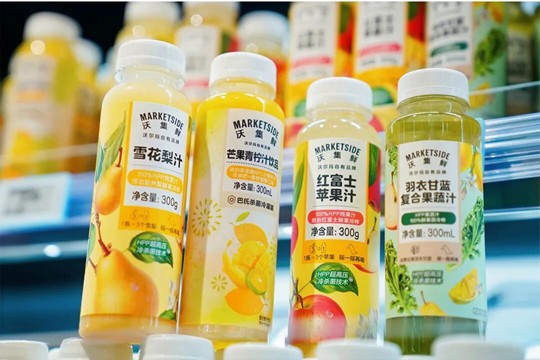
The initial data suggests a reality check: while buzz is high, direct e-commerce sales via Xiaohongshu have been modest. The true test is whether the immersive store experience can drive sustained foot traffic, larger basket sizes, and deeper brand loyalty.
The question resonating across the global retail industry is this: Can Walmart successfully replicate the membership-model success of Sam's Club with a new, innovative format and a powerful private brand tailored for the mass market? The Mashu Store experiment provides the first clues. Its ultimate lesson may be that the future of retail lies not in merely selling products, but in expertly curating and validating lifestyles—a playbook written as much by social media communities as by retail veterans.
Phygital is Non-Negotiable: The seamless QR-code bridge between physical products and social proof is a blueprint for reducing purchase friction.
Organize Around Consumer Passions, Not Your Logistics: The "Interest Island" model prioritizes discovery and experience over operational convenience, catering to the modern desire for curated experiences.
Private Brands Must Stand for Values: Success requires a clear promise (e.g., clean ingredients), strategic partnerships, and a flexible portfolio that fits modern household sizes.
Transformation Requires a Portfolio Approach: No single format wins. A synergistic mix of large destinations, convenient community shops, and instant digital delivery is essential.
(Note: All images in the original article are from Walmart's official website.)